1. Subframe
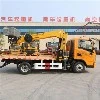
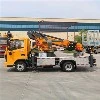
The subframe is a fundamental component of an aerial work platform, secured to the vehicle's chassis frame. It features horizontally extendable stabilizers at the rear, along with vertically extendable outriggers at the front and rear. A central slewing assembly is positioned in the middle, while an outrigger control valve is located at the front left. During aerial operations, the subframe serves to provide balance and stability, while also acting as a connecting structure between the vehicle chassis and the upper working assembly.
2. Slewing Mechanism
The slewing mechanism consists of a turntable, a cycloidal hydraulic motor, a planetary gear reducer, a slewing bearing, and a pinion gear. The rotating portion of the mechanism is mounted on the slewing bearing. The outer gear ring of the slewing bearing is fixed to the chassis, while the inner ring is connected to the turntable; the drive unit-comprising the hydraulic motor and the gear reducer-is mounted on the turntable itself. The cycloidal motor drives the planetary gear reducer and its attached pinion gear; as the pinion meshes with the outer gear ring, it causes the turntable to rotate (360°).
3. Working Boom
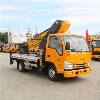
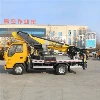
The working boom assembly comprises an upper folding arm, a main boom, and a balancing mechanism. During operation, the main boom is positioned at a 70° angle relative to the horizontal plane, while the upper folding arm is set at a 140° angle relative to the main boom. The balancing mechanism ensures stability for the boom and the platform during movement.
4. Central Rotary Joint
The central rotary joint is a hydraulic component designed to transfer pressurized oil-supplied by the hydraulic pump-from the stationary part of the vehicle to its rotating (moving) part. The core of the rotary joint is fixed to the chassis, while the outer housing is connected to the turntable. The central rotary joint contains multiple hydraulic channels-some for oil supply and others for oil return-with each channel isolated by sealing rings. The unit is also equipped with electrical contacts to ensure the continuity of both hydraulic and electrical circuits while the vehicle's upper assembly rotates. 5. Bidirectional Hydraulic Lock for Outriggers
The outrigger lock serves as a safety device for the outrigger cylinders, ensuring that the outriggers do not retract on their own once extended. It also prevents the occurrence of "soft outriggers"-a condition where a leak in the hydraulic or pneumatic lines causes the outriggers to lose their functionality-thereby averting serious accidents.