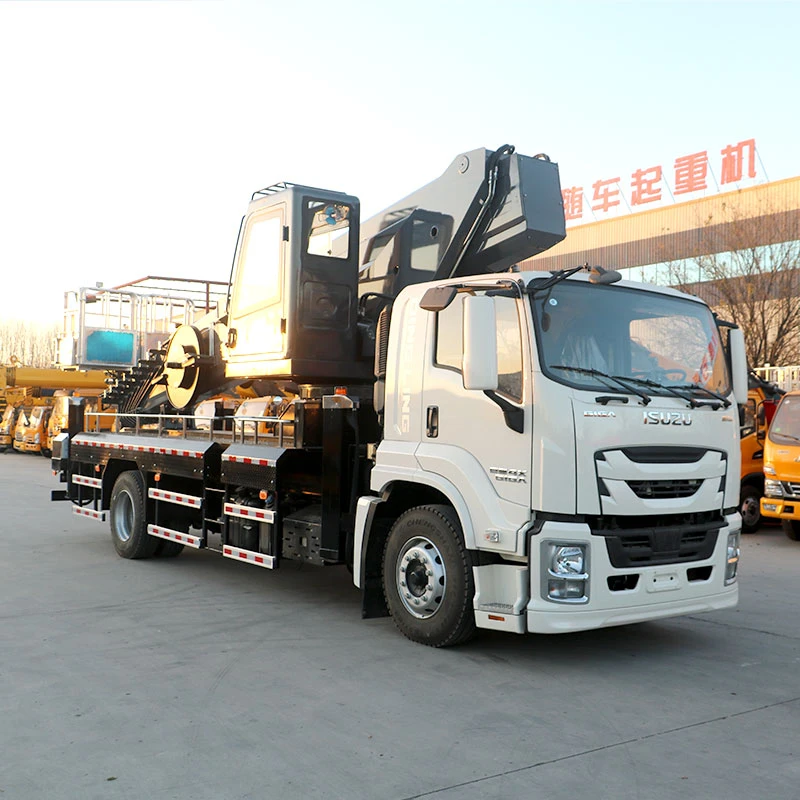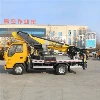
Technical Principles and Structural Features
A truck-mounted crane consists of three main components: a chassis, a lifting mechanism, and a control system. The chassis-typically a standard truck or a specialized vehicle-provides mobility. The lifting mechanism includes a telescopic boom, a slewing (rotating) mechanism, and a hoisting system, all powered by hydraulic or electric drives to perform lifting operations. The control system, operated via control levers or a wireless remote, enables precise handling. Its core advantage lies in its "on-vehicle" operational capability; it eliminates the need for separate transport equipment, allowing for rapid deployment at construction sites, logistics hubs, and other locations.
Application Scenarios and Industry Demand
Truck-mounted cranes are widely used in sectors such as construction, logistics, power utilities, and municipal services. On construction sites, they are used to lift steel reinforcement bars and concrete components; in logistics parks, they facilitate the quick loading and unloading of shipping containers or large cargo; and in power utility repairs, they are used for the efficient replacement of transformers or utility poles. Their flexibility makes them the preferred choice for small-to-medium-scale lifting tasks, particularly in environments with limited space or those requiring frequent relocation.
Industry Standards and Regulatory Requirements
As a category of "special equipment," truck-mounted cranes are subject to the following requirements:
Design and Manufacturing Standards: They must comply with national standards-such as GB/T 14406 (General-purpose Bridge Cranes) or GB/T 3811 (Design Specifications for Cranes)-to ensure structural integrity and safety.
Installation and Inspection: Following installation, the equipment must be inspected and approved by an authorized special equipment inspection agency. It is also subject to mandatory annual inspections, with a focus on the hydraulic system, wire ropes, and safety devices.
Operator Qualifications: Operators must hold a "Special Equipment Operator Certificate" and have completed professional training, ensuring they are familiar with the equipment's performance and emergency response procedures.
Registration System: The equipment must be registered with the local market regulatory authority and display an official "Special Equipment" usage label.